Posts

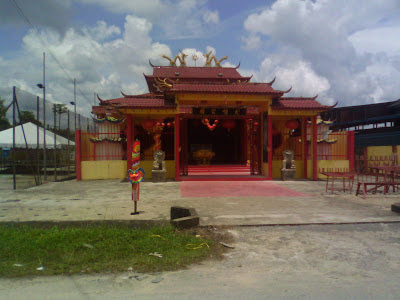
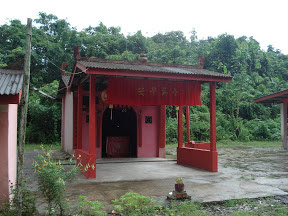
Eng Teck Temple, Samera, Sadong Jaya

Image
This temple is said to be older than the Tua Pek Kong Asajaya nearby, about 20 minutes drive by car from here. In the early days before the construction of the Asajaya / Sadong Jaya coastal highway, devotees nearby had to travel by boat to pay respect here.

Tua Pek Kong, Asajaya

Image
Like other Tua Pek Kong temple, Tua Pek Kong Asajaya started as a small wooden temple nearby a small river in Asajaya. The temple was initiated mainly due to many drowning incidents of local children nearby the current location. The current temple was rebuilt on the same location after many years of persistent efforts from local devotees on land issue.

Thai Pak Kung, Bintangor (民丹莪大伯公庙)

Image
Thai Pak Kung Bintangor was initiated in 1982. In earlier years, devotees in Bintangor had to travel to Sibu Tua Pek Kong to pay respect usually in express boat; The to and fro journey usually took a day . In the 80’s and earlier, land journey between Sibu and Bintangor was very inconvenient before the completion of the Durin Bridge and later the Upper Lanang Bridge across the Rejang River; coupled with the notorious Trans Borneo Highway, express boat transport was by default preferred. Thus, Thai Pak Kung was built. The land was approved earlier in 1978 by the authority, construction works started in 1982 and the temple committee was formed in 1985. Earlier Committee

Tua Pek Kong - A Study By Ngu See-Hing

Image
Ex tracts from 成大宗教與文化學報 第十三期, 2009 年12 月 頁97-138... Investigation into the Belief of Fu De Zheng Shen ( Earth God ) in Malaysia — Especially on Da Bo Gong temple ( Earth God Temple ) in Sarawak Abstract As the largest state of Malaysia, Sarawak located at the northern part of Borneo Island. The belief of Fu De Zheng Shen 福德正神 ( Earth God 土地 神 ) plays an extremely important role among Chinese society of the state mentioned. As the statistics shown, there is over 70 temples mainly consecrate Fu De Zheng Shen and still some uncountable temples proceed with the this Chinese belief. The Belief and the temples not only able to trace back a hundred years long lasting histories, but also suffuse all over the country. This essay is going to discuss about the built up of the Da Bo Gong temple 大伯公 廟, which included the relationship of ship based migration, the origin and argument of the deity, combination of TANG 唐 ( Chinese ) and FAN 番 ( Non-Chinese ) Earth God belief, ...

Poh Lin Shan (保灵山), Serikin, Bau – The Floating Buddha

Image
The host deity, the Golden Buddha was first found drifting along the Lundu river by a group of Iban boys in 2012. It is now hosted in Poh Lin Shan 保灵山 at the road junction to Serikin in Bau, in a natural limestone cave by devotees. One of the local devotees, Tan, earlier on was already planning for a place of worship in the area; coincidentally, this mysterious Golden Buddha Statue was found, the rest is history. It was said to be floating a thousand miles in the sea, at sitting position, before reaching Lundu. Could this be due to the mega tsunami in 2012? There are many mysterious stories or sayings on this floating Buddha and the limestone cave; one of those is about the mystical sangha shadow glimmering on a limestone wall in the cave, it is believed that the invisible image will only appear to those with faith. Undoubtedly, Poh Lin Shan has added another attraction in Bau recently to both the religious devotees and the tourists, and hopefully continued to bring pro...

Pa Shian Kung (八仙宫), Miri

Image
One of the very few temples in Sarawak hosted with 'Pa Shian' or the Eight Immortals Main Chamber of the Pa Shian Kung, Miri  Main Entrance

Fuk Teck Kong, Beliong - The Kiss Of The Dragon

Image
From a distance, Fuk Teck Gong temple is floating on water, like a floating lotus. Going to Beliong is a step back in time. Visitors are ferried across the Samarahan River by boatmen in sampans after a leisurely and refreshing drive through the Asajaya countryside. Alighting from the boats, they are greeted by farmers who peddle an array of fresh produce from their farms – sweet corn, pineapples, bananas and coconuts. A cluster of Malay houses emerges from among coconut palms as you walk towards the Kampung. There is no road in Beliong. People walk or cycle. At mid-day, or anytime of the day, the place is quiet. There is no sound of traffic except for the sputtering of the outboard engine from the sampan ferrying visitors to the village or that of the occasional motorbike. This is a place which seems out of this world, spared the trappings of modern development. Meaning of Beliong Beliong in Chinese is Wen Loong. Literally, it means kissing the dragon. But there ar...

Masjid Bandar Kuching - Oldest Mosque, facing demolition

Image
A more than 170 years old Indian Mosque in Kuching, Gambir Street, is facing demolition... “Currently, the plan for a new mosque or for Masjid Bandar Kuching is in the final stage of approval and very soon we can start building from the present site,", as reported by the Borneo Post... “The SHS is dismayed at the realisation that it is the private organisations and owners charged with the care of these historic buildings, who are promoting the destruction of these venerable examples of their own heritage, as in the case of the Summerhouse in the Museum Gardens, traditional shophouses, two town-centre Chinese temples.", as reported by the Star... "...although the mosque is the oldest in the State, few youths know about it.",  from e-borneo.com
Tann Hua Foo, Sibu

Image
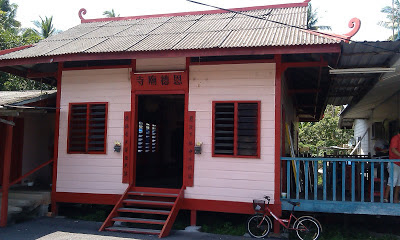
Tann Hua Foo Sibu is situated in the town center of Sibu, among the various churches of this Christian town. The monastery is said to be initiated long before the Eng Ang Teng (Tua Pek Kong Sibu). The current new monastery was named Guan Yin Chamber temporary during the construction, as the old temple was still operating, since there could not be two 'Tann Hua Foo' in one place. The name, 'Guan Yin Chamber', remains after that. There are few similar places of Tann Hua Foo in the outskirts of Sibu, such as Tann Hua Foo Sarikei; many of those were said to be (branch off) from here, Sibu. Tann Hua Foo Sarikei Tann Hua Foo or similar places of worship are found only in Central Sarawak where most of the Hockchew live, as the host deity is originated from China Hockchew (Fuzhou) province.

Sri Maha Marimamman - The Revival Of The Lost Temple

Image
Extracts from The New Straits Times... KUCHING: It may not have the grandeur of Batu Caves Temple complex in Selangor, but Mount Matang Sri Mahamariamman Temple complex can lay claim to be the first Hindu temple built in Sarawak. Located at the foothills of Mount Matang, the temple complex is also fascinating as it is made entirely of wood. Although it is only about 45km from here, one needs to spend about 45 minutes hiking up the hill. The temple was originally built by Indian workers who were brought here to work on the coffee plantation run by the state government back in 1867, and later with Rajah Charles Brooke, who took over and switched to tea in 1897. "The Indian workers brought a bronze deity when they arrived here but it was transferred to a temple in Batu Lintang when the tea estate was closed in 1912 due to poor harvest. "The temple was abandoned for 55 years until it was rediscovered by a local villager who was hunting nearby,"said penghul...

Tze Yin Khor, Sebuyau

Image
Sebuyau, a small coastal town resided between the Batang Lupar and Sungai Sebuyau; the small Sungai Sebuyau flows past Sebuyau directly to the South China Sea just at the Batang Lupar river mouth where the town is situated. This small fishing town is famous for the Ikan Terubuk, which is in high demand both locally and the West Malaysian market. Tze Yin Khor is situated near the Sebuyau river mouth; Tze Yin Khor Sebuyau shares the same host deities with Tze Yin Khor Sri Aman and Tze Yin Khor Lubok Antu, both are at the upstream of the Batang Lupar. The Main Host, Tze Pei Niang Niang, and two other host deities, Lord Hock Teck, or Tua Pek Kong. and Xuan Tian Shang Ti (玄天上帝; Heavenly Emperor). There are over 10,000 villagers in Sebayau, of whom two-thirds are fishermen living near the Sebuyau river. The Chinese, mostly Teochew, live near the town central, as grocery shops operators or businessmen.

Sri Maha Mariamman - The Lost Temple of Matang

Image
Extracts from The Borneo Post... "Sri Maha Mariamman Temple – The Lost Temple of Matang THE Sri Maha Mariamman (goddess of Mercy) temple, 1000 feet up the slope of the Matang mountain in the Kuching district was ‘lost’ for more than 50 years before it was discovered accidentally by a hunter back in the mid 1960s. It was said the hunter Abi bin Bengggali, stumbled upon an abandoned building on the slope of the mountain while searching for game. Intrigued, he explored the interior of the sturdy building made of belian which despite the ravage of time was still largely intact. Inside, he discovered relics of what was clearly a Hindu temple and taking fancy of a carved wooden elephant, he took it home. It proved to be a traumatic mistake for that night his house shook violently and in his sleep Abi dreamt that he must return the statue to the temple. Needless to say the hunter lost no time returning the statue to the temple and his strange adventure became the talk of ...

Fo Pao Kung, Batu Kawa

Image
One of the many traditional Chinese temples in Batu Kawa, Kuching

Woon Hua Kung, Batu Kawa

Image
Woon Hua Kung, one of the many small traditional Chinese temples in the Batu Kawa area. There are many such temples in this area, mostly built in the early Chinese settlement time, nearby to the Sarawak river tributaries, as river was the most economical & convenient means of transport during that time. In the Batu Kawa area along, there were around 10 such early settlements in these Sarawak river tributaries.