Posts

Showing posts with the label temple

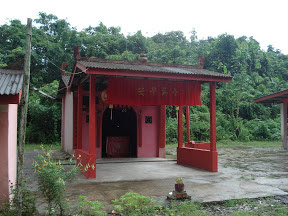
Eng Teck Temple, Samera, Sadong Jaya

Image
This temple is said to be older than the Tua Pek Kong Asajaya nearby, about 20 minutes drive by car from here. In the early days before the construction of the Asajaya / Sadong Jaya coastal highway, devotees nearby had to travel by boat to pay respect here.

Tua Pek Kong - A Study By Ngu See-Hing

Image
Ex tracts from 成大宗教與文化學報 第十三期, 2009 年12 月 頁97-138... Investigation into the Belief of Fu De Zheng Shen ( Earth God ) in Malaysia — Especially on Da Bo Gong temple ( Earth God Temple ) in Sarawak Abstract As the largest state of Malaysia, Sarawak located at the northern part of Borneo Island. The belief of Fu De Zheng Shen 福德正神 ( Earth God 土地 神 ) plays an extremely important role among Chinese society of the state mentioned. As the statistics shown, there is over 70 temples mainly consecrate Fu De Zheng Shen and still some uncountable temples proceed with the this Chinese belief. The Belief and the temples not only able to trace back a hundred years long lasting histories, but also suffuse all over the country. This essay is going to discuss about the built up of the Da Bo Gong temple 大伯公 廟, which included the relationship of ship based migration, the origin and argument of the deity, combination of TANG 唐 ( Chinese ) and FAN 番 ( Non-Chinese ) Earth God belief, ...

Pa Shian Kung (八仙宫), Miri

Image
One of the very few temples in Sarawak hosted with 'Pa Shian' or the Eight Immortals Main Chamber of the Pa Shian Kung, Miri  Main Entrance

Fuk Teck Kong, Beliong - The Kiss Of The Dragon

Image
From a distance, Fuk Teck Gong temple is floating on water, like a floating lotus. Going to Beliong is a step back in time. Visitors are ferried across the Samarahan River by boatmen in sampans after a leisurely and refreshing drive through the Asajaya countryside. Alighting from the boats, they are greeted by farmers who peddle an array of fresh produce from their farms – sweet corn, pineapples, bananas and coconuts. A cluster of Malay houses emerges from among coconut palms as you walk towards the Kampung. There is no road in Beliong. People walk or cycle. At mid-day, or anytime of the day, the place is quiet. There is no sound of traffic except for the sputtering of the outboard engine from the sampan ferrying visitors to the village or that of the occasional motorbike. This is a place which seems out of this world, spared the trappings of modern development. Meaning of Beliong Beliong in Chinese is Wen Loong. Literally, it means kissing the dragon. But there ar...

Tann Hua Foo, Sibu

Image
Tann Hua Foo Sibu is situated in the town center of Sibu, among the various churches of this Christian town. The monastery is said to be initiated long before the Eng Ang Teng (Tua Pek Kong Sibu). The current new monastery was named Guan Yin Chamber temporary during the construction, as the old temple was still operating, since there could not be two 'Tann Hua Foo' in one place. The name, 'Guan Yin Chamber', remains after that. There are few similar places of Tann Hua Foo in the outskirts of Sibu, such as Tann Hua Foo Sarikei; many of those were said to be (branch off) from here, Sibu. Tann Hua Foo Sarikei Tann Hua Foo or similar places of worship are found only in Central Sarawak where most of the Hockchew live, as the host deity is originated from China Hockchew (Fuzhou) province.

Sri Maha Marimamman - The Revival Of The Lost Temple

Image
Extracts from The New Straits Times... KUCHING: It may not have the grandeur of Batu Caves Temple complex in Selangor, but Mount Matang Sri Mahamariamman Temple complex can lay claim to be the first Hindu temple built in Sarawak. Located at the foothills of Mount Matang, the temple complex is also fascinating as it is made entirely of wood. Although it is only about 45km from here, one needs to spend about 45 minutes hiking up the hill. The temple was originally built by Indian workers who were brought here to work on the coffee plantation run by the state government back in 1867, and later with Rajah Charles Brooke, who took over and switched to tea in 1897. "The Indian workers brought a bronze deity when they arrived here but it was transferred to a temple in Batu Lintang when the tea estate was closed in 1912 due to poor harvest. "The temple was abandoned for 55 years until it was rediscovered by a local villager who was hunting nearby,"said penghul...

Fo Pao Kung, Batu Kawa

Image
One of the many traditional Chinese temples in Batu Kawa, Kuching

Woon Hua Kung, Batu Kawa

Image
Woon Hua Kung, one of the many small traditional Chinese temples in the Batu Kawa area. There are many such temples in this area, mostly built in the early Chinese settlement time, nearby to the Sarawak river tributaries, as river was the most economical & convenient means of transport during that time. In the Batu Kawa area along, there were around 10 such early settlements in these Sarawak river tributaries.

The Guan Gong At The Doorway, Debak.

Image
The Debak Lung San Temple was said to be initiated before 1930, the earlier temple was a simple hut about 2 kilometers from the current location. The history of this small town, Debak, is more than 130 years. Earlier on Lord Tua Pek Kong was the only host deity; Xuan Tian Shang Ti (玄天上帝) was later hosted in by devotees’ request. Guan Gong (關公) joined in recently, forming the current 3 main host deities in this temple. Earlier, it was said that Guan Gong or similar character was seen many times near the temple doorstep. It was later learnt that Lord Guan Gong wanted to be hosted in this temple; that was the legend how Guan Gong became the host deity of Lung San Temple in Debak.

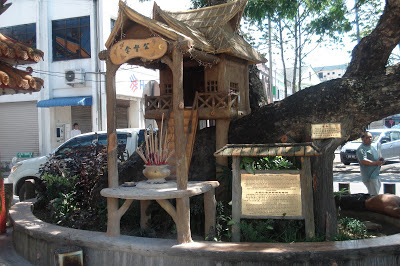
The 'Rain Tree' of the Sibu Tua Pek Kong

Image
The 'Rain Tree' & Na Tuk Kong in front of Eng Ann Teng, Sibu Commemorative Plaque of the 'Rain Tree' Extracts from the Commemorative Plaque... "This splendid tree, locally known as ‘Kayu Hujan’ or ‘Rain Tree’ (Samanea-Saman) has been confirmed by the expert from the Sarawak Forestry Department that it is estimated to be more than 100 years old. It is believed that it was planted by one of the early unknown settlers from China, presumably he was one of the earliest ‘Beca’ (trishaw) operator in Sibu town. Finding himself unable to withstand the hot tropical sun, he planted this fast growing luxuriant tree, hoping it would give him a cool shade and thus, creating a strategic & focal point for him to continue his livelihood as ‘Beca’ operator to ferry nearby women-folk to worship at the nearby Tua Pek Kong Temple. The tree had also borne some interesting legend as pointed out by one local historian.” Eng Ann Teng, Sibu ...

Rajah Charles Brooke & the Temple

Image
Chu Sze Kung was first found near the current Kuching General Hospital by the local Teoh Chew pioneers around the end of 19th Century; there was a small Teoh Chew community in the area around that time. There is no records on the details. The Rajah was associated with Lord Chu Sze according to a legend. At one time, in the 19th Century, Rajah Charles Brooke was galloping on a horse back along Green Road, near the current General Hospital; suddenly, he felt sick & fell blank to the ground. As he was unconscious, there appeared an old man before him & fed him some medicine. When he woke up, he saw the old man disappeared before a small temple not far from him. As he entered the temple, he was shocked that the host deity looked alike the old man who saved him in the dream. It seemed that the God of the temple had saved him. As he returned to the Astana (the palace), he quickly granted the piece of land to the temple officially, with a land title. Thereafter, the stor...
Hock Teck Tsyr, Bintulu

Image
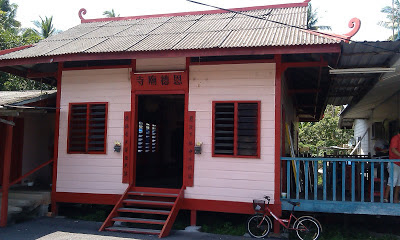
Hock Teck Tsyr, Bintulu has just completed the new building before the 2009 Chinese New Year. The official date for opening will be after the CNY 2009, probably in March 2009.

The Butcher Who Turned God

Image
Hiang Thian Siang Ti or Xuan Tian Shang Ti is the host deity of Shang Ti Temple, Kuching and many other similar temples in Sarawak or Malaysia. Accordingly, the Sagely One was born in 581 A.D. in China. Before he got enlightened, he worked as a butcher for many years. As he turned old, he regretted much for the killings he had done as a butcher and decided to go to Wudan San (Mt Wudan in China) to practice the Taoist ways. As such, he threw his butcher knife to the river; later, he took back the butcher knife from the river fearing that the tool might hurt the river creatures. He later cut his own stomach & threw his organs to the river in order to purify himself for the sins he had done as a butcher. At that moment, holy light descended from the sky & escorted his soul to Wudan San for the Way. This is the legendary story of the Sagely One who was later became God from an ordinary butcher.

Lian Hua San - San Ching Pantheon, Miri

Image
 Extracts from Commemorative Plaque of Lian Hua San San Chin Pantheon, Miri... "Historical brief of ‘Miri Lian Hua San San Ching Taoism Association’ Tao means literally the ‘path’ and is a universal principle that underlies everything from the creation of galaxies to the interaction of human being. Taoism is a philosophy and San Ching is the phenomenal belief of Taoism. ‘Miri Lian Hua San San Ching Tian’ is originated from ‘Miri San Ching Yuk Fang Tian’ that was formed since 1972. After the unfortunate demise of our first Chairman of the Association – Mr Chiew Choon Lim in the late 1998, a new committee was formed in 1999 under the guidance of Mr Hii Siew Ong to complete the visionary Pantheon of ‘San Ching’. The Pantheon of ‘Miri San Ching’ is located on a land sized 1.475 acres, with a total built-up area of approximately 2000 sq meters. The development plan was designed and constructed in accordance to approved plan by Miri Municipal Council and Land & ...

Ching San Yen – Her Feng Shui & the City of Kuching

Image
About two centuries ago, Ching San Yen area was already a prosperous port for Kuching. It served as one of the two major ports of entry to Kuching or Sarawak at large at that time (the other one is the Santubong river mouth), for vessels from the South China Sea. The Brooke Administration at that time also had custom offices or the like established for purposes of taxation & other clearance. The temple was already established at that time for the Chinese immigrants. It also served as a first stop for the newly arriving Chinese immigrants to pay respect and to thank for the long safe journey, before moving on to the hinterland or other parts of Sarawak. Many adherents believe that Ching San Yen was built on a good Feng Shui; the prosperity of Kuching is associated with that since then. Accordingly, Ching San Yen is seated on a Golden Turtle in the North (the Muara Tebas hill), and facing a flowing river in front on the South. The location might have been chosen car...