Posts

Showing posts with the label Kuching

Woon Hua Kung, Batu Kawa

Image
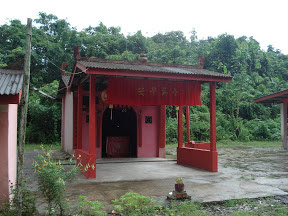
Woon Hua Kung, one of the many small traditional Chinese temples in the Batu Kawa area. There are many such temples in this area, mostly built in the early Chinese settlement time, nearby to the Sarawak river tributaries, as river was the most economical & convenient means of transport during that time. In the Batu Kawa area along, there were around 10 such early settlements in these Sarawak river tributaries.

Rajah Charles Brooke & the Temple

Image
Chu Sze Kung was first found near the current Kuching General Hospital by the local Teoh Chew pioneers around the end of 19th Century; there was a small Teoh Chew community in the area around that time. There is no records on the details. The Rajah was associated with Lord Chu Sze according to a legend. At one time, in the 19th Century, Rajah Charles Brooke was galloping on a horse back along Green Road, near the current General Hospital; suddenly, he felt sick & fell blank to the ground. As he was unconscious, there appeared an old man before him & fed him some medicine. When he woke up, he saw the old man disappeared before a small temple not far from him. As he entered the temple, he was shocked that the host deity looked alike the old man who saved him in the dream. It seemed that the God of the temple had saved him. As he returned to the Astana (the palace), he quickly granted the piece of land to the temple officially, with a land title. Thereafter, the stor...

Chu Sze Kung, Tabuan Laru, Kuching

Image
A new temple, Chu Sze Kung, has just officially opened in April 2009 at Tabuan Laru, Kuching. Before completion... After completion...

The Butcher Who Turned God

Image
Hiang Thian Siang Ti or Xuan Tian Shang Ti is the host deity of Shang Ti Temple, Kuching and many other similar temples in Sarawak or Malaysia. Accordingly, the Sagely One was born in 581 A.D. in China. Before he got enlightened, he worked as a butcher for many years. As he turned old, he regretted much for the killings he had done as a butcher and decided to go to Wudan San (Mt Wudan in China) to practice the Taoist ways. As such, he threw his butcher knife to the river; later, he took back the butcher knife from the river fearing that the tool might hurt the river creatures. He later cut his own stomach & threw his organs to the river in order to purify himself for the sins he had done as a butcher. At that moment, holy light descended from the sky & escorted his soul to Wudan San for the Way. This is the legendary story of the Sagely One who was later became God from an ordinary butcher.

Ching San Yen – Her Feng Shui & the City of Kuching

Image
About two centuries ago, Ching San Yen area was already a prosperous port for Kuching. It served as one of the two major ports of entry to Kuching or Sarawak at large at that time (the other one is the Santubong river mouth), for vessels from the South China Sea. The Brooke Administration at that time also had custom offices or the like established for purposes of taxation & other clearance. The temple was already established at that time for the Chinese immigrants. It also served as a first stop for the newly arriving Chinese immigrants to pay respect and to thank for the long safe journey, before moving on to the hinterland or other parts of Sarawak. Many adherents believe that Ching San Yen was built on a good Feng Shui; the prosperity of Kuching is associated with that since then. Accordingly, Ching San Yen is seated on a Golden Turtle in the North (the Muara Tebas hill), and facing a flowing river in front on the South. The location might have been chosen car...

Tua Pek Kong - When is thy birthday?

Image
There are many Tua Pek Kong temples in Sarawak; the most famous one is Tua Pek Kong Temple in Kuching. The Tua Pek Kong temple in Limbang is called Hock Teck Tsyr, and in Serian it is called Tai Pak Kung. The generic name Tua Pek Kong temple here refers to temples with Lord Tua Pek Kong as the Host Deity. Many Tua Pek Kong temples in Sarawak were found at least fifty years ago. Many dialects differences, geographical barrier, communication hindrance and the like in the past, had given rise to the different names of the temples, with the same host deity. There is no surprise that Lord Tua Pek Kong also has 'many' birthdays, with more or less the same reasons. Eng Ann Teng, Sibu The Eng Ann Teng in Sibu celebrates the birthday on 29th day of 3rd month of the lunar calendar. Others state differently, such as a notice of a Shrine near Tian Hou Temple in Carpenter Street/ Wayang Street, Kuching, indicates 1st day of 2nd month as the birthday. As such, the com...

Hong San Si, Kuching – the legend of the Host Deity

Image
Shen Ong Kong or Kong Teck Choon Ong (in Hokkien dialect) or Guang Ze Zun Wan (广泽尊王) is the host deity of Hong San Si Kuching & many other similar temples in Sarawak. Unlike many other host deities, Shen Ong Kong has a childlike face with teenage energetic appearance, after all, he was only 16 years old when he (or his human transformation) died, or departed. Accordingly, he was born in 923 AD on 22nd day of 2nd Lunar Month in Ann Che District in Southern Fujian Province of China, in a farming family. Like many other legendary heavenly beings born into this physical world, the sky was adorned with colorful holy light, and fragrance permeated the whole room during his birth. Kuo Chung Fook was his name. As a child, he was intelligent & very filial to his parents. He had a very special squared facial feature with big round eyes. However, his parents passed away earlier in his childhood, and he had to work as a shepherd for a landlord called Yang, away from his home...
Tua Pek Kong Temple, Kuching

Image
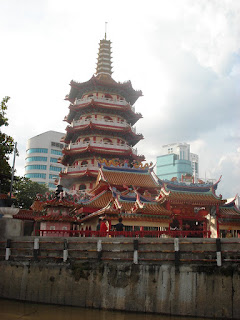
Tua Pek Kong Temple is one of the oldest (or the earliest known) Chinese temple in Sarawak; it is also one of the most famous and mentioned tourist destination in Sarawak. The temple was believed to be built around the year 1800, more than two centuries; the earliest known official land title issued by Charles Brooke was 29 August 1871. Like many of the earlier Chinese temple in Sarawak, it was a small & simple hut; the first known renovation was done in the year 1856, and subsequently it was upgraded with ceramic roofing & partial brick walls in 1863. By the year 1880 when cement was introduced into Sarawak, major parts of the temple were then concreted as to existing look. The earlier management of the temple before the Japanese occupation was elected informally by yearly cast lots of getting one representative with two ‘taukey’ to assist the required periodic ceremonial & religious occasions. After the war, the temple was managed by five Chinese ...

Tua Pek Kong Kuching - the Feng Shui Legend

Image
The Kuching Tua Pek Kong Temple was once seated on the best Feng Shui location in Kuching; as according to the Feng Shui principle, a hill at the back, a small and smooth flowing river in front (the lost Sg Kuching), and the best front view of the highest peak in the area, Gunung Serapi. The temple was built more than two centuries ago, long before James Brooke, the first White Rajah of Sarawak, arrived in Kuching. Like most Chinese temples, the temple prosperity affected and associated highly to the businesses, emotion and activities of the local Chinese community in the early days where majority were followers of Taoist related faith. It was also one of the few buildings that survived the 1884 the Great Fire of Kuching, where most Chinese believed was due to good Feng Shui. It was said that after the 1857 Chinese Insurrection in Bau, a gold mine township nearby, the Brooke Administration was worried about the Tua Pek Kong dominance and its influence to the local Kuching...